An EOT crane - short for Electric Overhead Travelling crane - is one of the most widely used material handling machines in Indian industry. You will find them in steel plants, fabrication units, warehouses, workshops and heavy engineering factories. They lift and move heavy loads safely across a bay without a single worker breaking their back.
But an EOT crane is not a single machine. It is a system of several components, each doing a specific job. If you are buying, maintaining or operating one, understanding the main EOT crane parts helps you make better decisions - from choosing the right specification to diagnosing a breakdown quickly.
This guide breaks down every major component of an EOT crane and explains exactly what each one does.
The Main EOT Crane Parts Explained
1. Bridge (Girder)
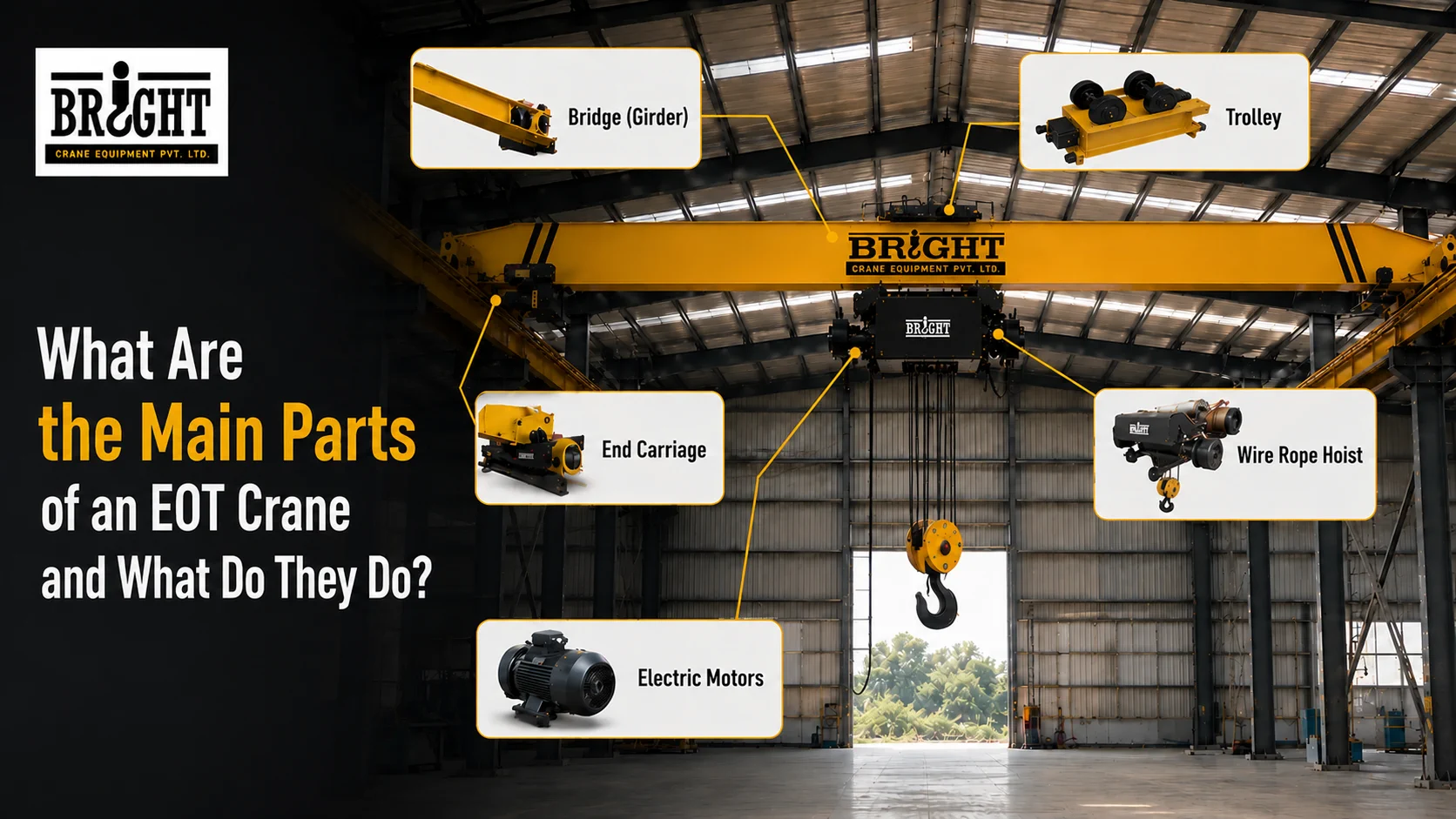
The bridge is the main horizontal structure of the crane. It spans the width of the bay and carries the entire load during lifting. Think of it as the backbone of the whole system.
Bridges come in two types. A single girder crane uses one main beam and is suited to lighter loads and shorter spans. A double girder crane uses two beams and handles heavier loads, longer spans and higher lifting heights. The choice between them depends on your capacity and span requirements.
What it does: Provides the main load-bearing structure and supports the trolley and hoist as they travel across the bay.
2. End Carriage (End Truck)
The end carriages are mounted at both ends of the bridge girder. They house the wheels that allow the entire crane to travel along the runway rails fixed to the building structure.
The end carriage is what gives the crane its long-travel movement - the ability to move the whole bridge forward and backward along the length of the bay.
What it does: Carries the bridge on wheels and enables the long-travel motion of the crane along the runway.
3. Hoist
The hoist is the lifting heart of the crane. It is the mechanism that actually raises and lowers the load. Most EOT cranes use either a wire rope hoist or an electric chain hoist depending on the capacity.
The hoist includes the drum, wire rope or load chain, the hook and the lifting motor. For heavy industrial applications, wire rope hoists are standard because they handle higher capacities and larger lifting heights.
What it does: Performs the vertical lifting and lowering of the load using a motor, drum and rope or chain.
4. Trolley
The trolley is the unit that carries the hoist and moves it across the bridge girder. This gives the crane its cross-travel movement - side to side across the width of the bay.
Together, the long travel of the bridge and the cross travel of the trolley let the hook reach almost any point within the crane's working area.
What it does: Carries the hoist and moves it horizontally across the bridge, providing cross-travel motion.
5. Electric Motors
An EOT crane uses separate motors for its three motions - hoisting (up and down), cross travel (trolley movement) and long travel (bridge movement). These motors are the driving force behind every movement the crane makes.
Motor quality directly affects performance and duty cycle. Heavy-duty applications require motors rated for higher duty classes so they can handle continuous operation without overheating.
What it does: Powers the three independent motions of the crane - lifting, cross travel and long travel.
6. Control System (Pendant / Remote)
The control system is how the operator commands the crane. This is usually a pendant control station that hangs from the crane, or a wireless radio remote for greater flexibility and operator safety.
Modern control panels also include contactors, relays and protection devices that manage the electrical supply to the motors safely.
What it does: Lets the operator control all crane movements safely and precisely from the floor or a distance.
7. Wheels and Rails
The crane travels on wheels that run along rails. There are two sets - the runway rails fixed to the building on which the end carriages run, and the rails on the bridge girder on which the trolley runs.
What it does: Provides smooth, guided movement for both the bridge and the trolley.
8. Long Travel and Cross Travel Mechanisms
These mechanisms include the gearboxes, couplings and drive wheels that convert motor power into the actual travelling movement of the bridge and trolley. Smooth, jerk-free travel depends heavily on the quality of these components.
What it does: Transmits motor power to the wheels to move the bridge and trolley smoothly.
9. Safety Devices
Safety is built into every quality EOT crane through several components. These are not optional extras - they protect operators, loads and the machine itself.
- Overload limiter - prevents the crane from lifting beyond its rated capacity.
- Limit switches - stop the hook and travel motions at safe end positions.
- Brakes - hold the load securely and stop motion instantly when needed.
- Buffers and end stops - prevent the crane from over-travelling off the rails.
What they do: Protect the operator, the load and the crane from accidents and overloading.
10. Down Shop Lead (DSL) / Power Supply System
The crane needs a continuous power supply while it travels. This is provided by a Down Shop Lead system - either a conductor bar system or a festoon cable arrangement - that feeds electricity to the moving crane along the length of the runway.
What it does: Supplies electrical power to the moving crane continuously and safely.
Why Understanding EOT Crane Parts Matters
Knowing these components is not just technical trivia. It has real practical value:
- Better buying decisions - you can specify the right girder type, hoist and duty class for your load.
- Faster troubleshooting - when something fails, you know which part to check.
- Smarter maintenance - you can plan inspections for wear-prone parts like wheels, brakes and ropes.
- Safer operation - you understand what each safety device does and why it must never be bypassed.
An EOT crane is a long-term industrial asset. When each part is correctly specified, well built and properly maintained, the crane runs reliably for 15 to 20 years.
Conclusion
An EOT crane works as a coordinated system - the bridge carries the load, the end carriages move it along the bay, the trolley shifts it sideways, the hoist lifts it, and the motors, controls and safety devices tie everything together. Every part has a clear job, and the performance of the whole crane depends on the quality of each one.
When choosing an EOT crane, always ask about the specification of these individual parts - the girder type, hoist capacity, motor duty class and safety features. A crane built from quality components is safer, more reliable and far more cost-effective over its lifetime.
Frequently Asked Questions
1. What does EOT crane stand for?
EOT stands for Electric Overhead Travelling crane. It is an overhead lifting machine operated electrically that travels along runway rails to lift and move heavy loads across an industrial bay.
2. What are the main parts of an EOT crane?
The main EOT crane parts are the bridge (girder), end carriage, hoist, trolley, electric motors, control system, wheels and rails, travel mechanisms, safety devices and the power supply (DSL) system. Each part performs a specific function in lifting and moving loads.
3. What is the difference between a single girder and double girder EOT crane?
A single girder EOT crane uses one main beam and suits lighter loads and shorter spans. A double girder crane uses two beams and handles heavier loads, longer spans and greater lifting heights. Double girder cranes are used for heavy-duty industrial applications.
4. What is the function of the hoist in an EOT crane?
The hoist performs the actual lifting. It raises and lowers the load using a motor, drum and either a wire rope or load chain, with a hook to hold the load. It is the core lifting component of the crane.
5. What safety devices are used in an EOT crane?
Common safety devices include an overload limiter, limit switches, electromagnetic brakes, and buffers or end stops. These protect the operator, the load and the crane from accidents and overloading.
6. How long does an EOT crane last?
A well-built and properly maintained EOT crane typically lasts 15 to 20 years. Service life depends on the quality of components, the duty cycle it operates under and regular preventive maintenance.